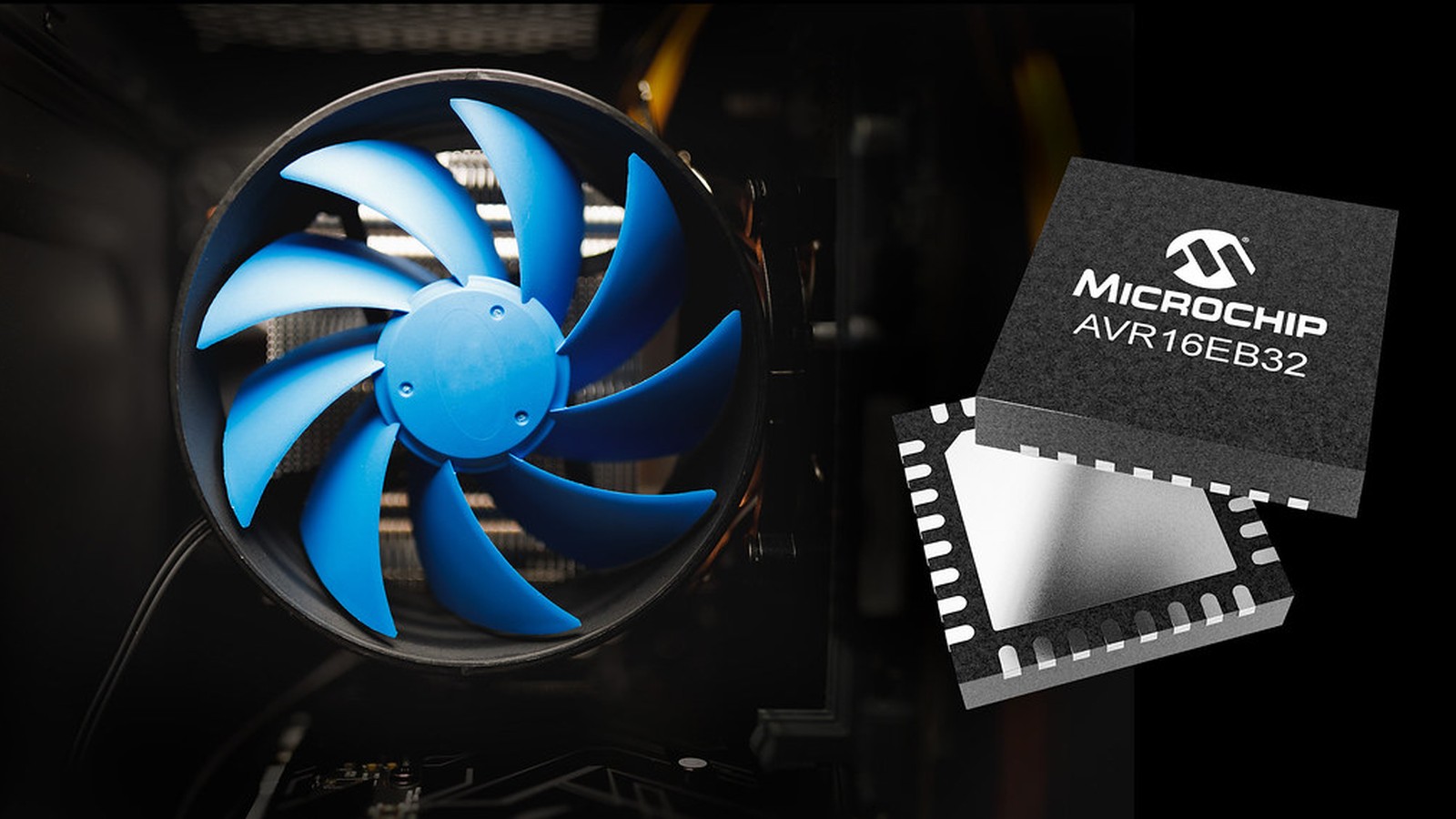
A cheap cooling fan can make an otherwise polished project feel rough. It may buzz at low speed, shudder when starting, or waste energy because its motor is being driven with crude timing. Fixing those problems usually means better motor-control hardware and more sophisticated software.
Microchip's AVR EB family, announced on December 11, 2023, approached the problem from another direction. Instead of asking an inexpensive 8-bit processor to calculate every motor waveform in software, Microchip added peripherals designed to generate and adjust those waveforms in hardware.
The result is an AVR family aimed at brushless direct-current motors, commonly shortened to BLDC motors. These motors use electronic switching rather than mechanical brushes to energize their coils. They are common in cooling fans, pumps, appliances, vehicle accessories, and small industrial machines because they can run efficiently and last a long time.
Why does a BLDC motor need a controller?
A brushed motor can begin turning when voltage is applied because its internal brushes switch current between coils as the shaft rotates. A BLDC motor replaces those wearing mechanical contacts with electronic switching. The controller must energize the correct motor phases in the correct sequence.
Think of three people pushing a playground roundabout. If they push at the right moments, the platform accelerates smoothly. If one pushes too early or too late, the motion becomes uneven. A three-phase BLDC controller performs the electrical version of that coordination, switching current through several windings as the rotor moves.
The shape of the drive waveform matters. A simple trapezoidal waveform changes between flat levels and is relatively straightforward to generate. A sinusoidal waveform follows a smooth curve and can reduce audible noise and torque ripple. Torque ripple is the repeating variation in turning force that can create vibration.
Microchip positioned AVR EB as a cost-conscious controller that could create both waveform types and adjust speed, timing, and shape while the motor was running.
What hardware did Microchip add?
The headline peripheral is Timer/Counter E, or TCE. A timer/counter is a hardware block that counts clock pulses and changes output pins at precisely chosen values. Microcontrollers often use timers to generate pulse-width modulation, better known as PWM. PWM controls average power by switching an output on and off quickly and varying how long it remains on during each cycle.
TCE is a 16-bit timer with four compare channels. A compare channel watches the counter and triggers an output change when a programmed value is reached. Multiple channels let the controller coordinate several motor signals from one timing base.
The family also includes Waveform Extension, or WEX. This hardware can turn timer signals into the paired outputs needed for motor-control stages. It supports dead-band insertion, sometimes called dead time. Dead time is a deliberately short pause between switching off one power transistor and switching on its partner.
That pause is important. If both transistors in one half-bridge conduct at the same time, they can create a near-direct path between the power rails. The resulting current spike, known as shoot-through, can overheat or destroy the power stage. A hardware dead-time generator produces the pause more consistently than code that must execute at exactly the right moment.
AVR EB also introduced a 24-bit Timer/Counter F, or TCF, for accurate frequency generation and timing. A wider counter can represent longer intervals or finer timing steps before it rolls over, depending on its clock configuration.
What does near-zero latency mean here?
Microchip said the AVR EB peripherals could make waveform adjustments with near-zero latency. Latency is the delay between an input changing and the system responding. In a software-only controller, the processor may need to detect an event, enter an interrupt routine, calculate a new value, and write that value to a timer.
An interrupt is a hardware signal that temporarily pauses the normal program so an urgent event can be handled. Interrupts are useful, but they still take time and can be delayed by other high-priority work.
AVR's event system lets compatible peripherals pass signals directly between one another without waiting for the central processing unit, or CPU. A timer, analog comparator, or sensor interface can trigger another hardware block. This is what Microchip means by core-independent peripherals: useful work continues in dedicated hardware while the CPU handles the larger application.
The phrase does not mean the processor is irrelevant. Firmware still configures the timers, interprets operating conditions, manages faults, and decides the motor's target behavior. Hardware simply handles the repetitive timing once it has been set up.
How can this reduce noise and vibration?
Motor noise is not one single problem. Mechanical imbalance, bearings, mounting, magnetic forces, switching frequency, and control timing can all contribute. A microcontroller cannot repair a damaged bearing, but it can improve how the coils are energized.
Smoother waveform control reduces abrupt changes in torque. Adjustable timing helps the magnetic field stay aligned with the rotor as speed and load change. Higher-quality PWM generation can move switching noise away from the frequencies people hear, although the power electronics and motor must support the chosen frequency.
Those improvements can also increase efficiency. Energy that becomes unwanted vibration or heat is not turning the load. Better commutation, which is the process of switching motor phases, can deliver more useful motion from the same electrical input.
The gotcha is that a motor-control microcontroller is not a complete motor driver. AVR EB's pins cannot directly supply the current needed by most BLDC windings. A practical design still needs gate drivers, power transistors, current sensing, protection, a suitable power supply, and careful printed-circuit-board layout.
Where can makers start?
Microchip introduced the AVR16EB32 Curiosity Nano evaluation kit with the family. An evaluation kit places the microcontroller on a small development board with programming and debugging support. It lowers the risk of designing a custom board before the firmware concept works.
The family is supported by MPLAB X, Microchip Studio, and IAR Embedded Workbench. An integrated development environment, or IDE, combines code editing, building, device programming, and debugging. MPLAB Code Configurator Melody can generate setup code for supported peripherals through a graphical interface.
Generated configuration is especially useful for advanced timers, but I would not treat it as a substitute for understanding the power stage. Verify output polarity, dead time, startup behavior, and fault handling with an oscilloscope before connecting a valuable motor. An oscilloscope displays how electrical signals change over time.
Start at a low supply voltage and with a current-limited bench supply when possible. Confirm that complementary transistor outputs never overlap. Make sure a stopped processor leaves the driver in a safe state. A debugger can pause firmware while timer hardware keeps running, so stopping at a breakpoint may not stop the motor unless the system was designed to do so.
Why an 8-bit AVR can still make sense
Motor control is often associated with fast digital signal controllers and 32-bit microcontrollers. Those devices are appropriate for demanding field-oriented control, high-power inverters, and applications that need extensive mathematical processing. They are not automatically the best choice for every fan, pump, or actuator.
An 8-bit device can be easier to qualify, cheaper to purchase, and simpler to integrate when specialized peripherals do most of the timing. AVR EB reflects a broader Microchip strategy: keep the processor modest, then add hardware aimed at a particular job.
The family does not remove the need to understand BLDC control. It changes where the difficult timing happens. Instead of asking firmware to toggle every signal at exactly the right microsecond, the developer configures hardware built to repeat that work reliably.
For makers and product designers, that creates an approachable path into quieter fans, compact pumps, and other small motor systems. The useful lesson is larger than this one AVR family. A processor's clock speed is only part of its capability. The right peripheral can matter far more than a faster CPU that has to perform the same job in software.
I like this family for what it teaches: a modest chip can run a motor smoothly when the timing happens in hardware. Just remember the chip is not the driver, so plan the power stage separately.
Sources and image credits
- Microchip announcement: AVR EB family for BLDC motor control
- Microchip AVR EB product family
- Official launch image supplied by Microchip Technology with explicit permission to publish.
- Square and vertical crops are edited from the same source image.