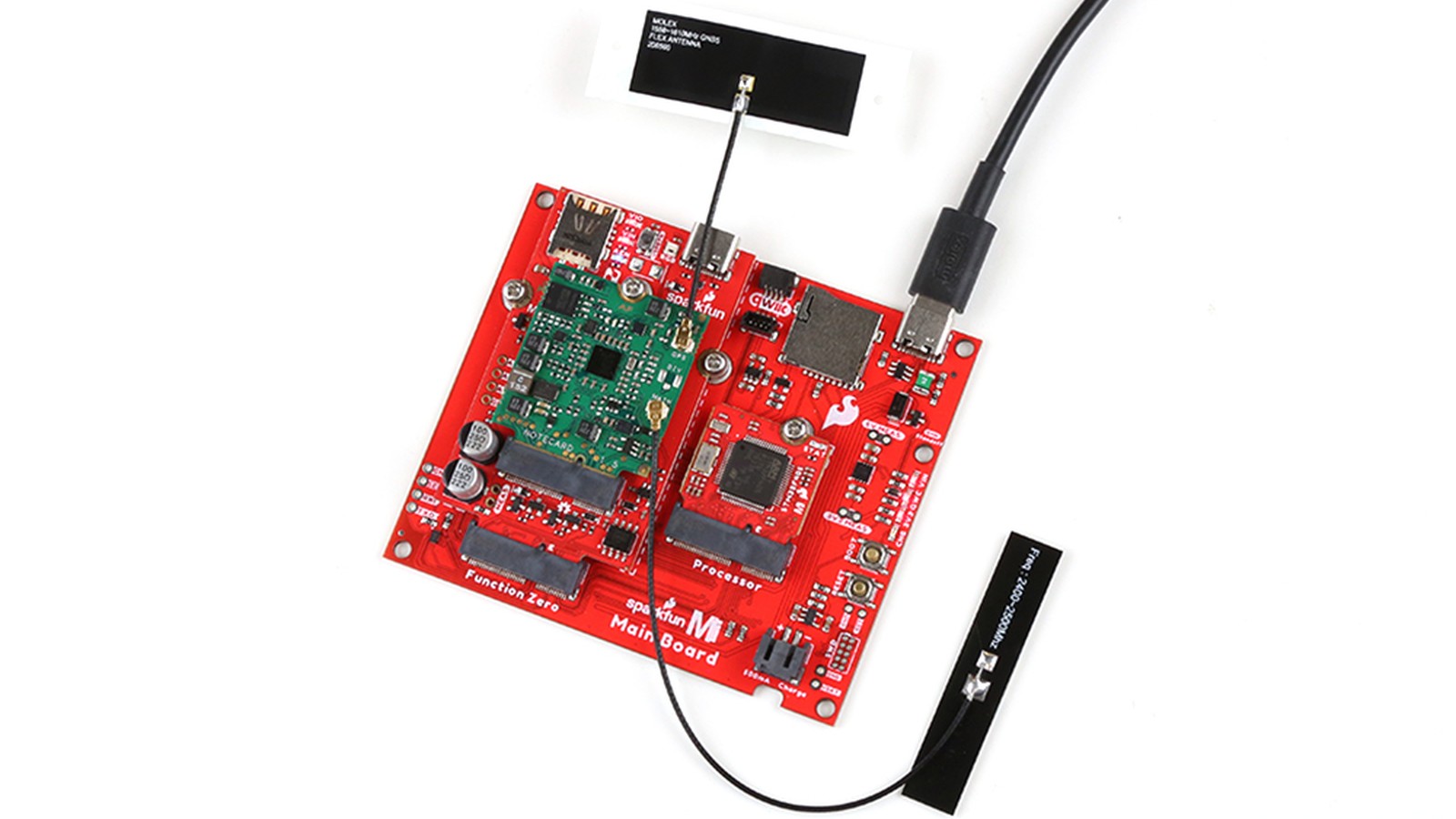
SparkFun opened 2023 by giving its MicroMod ecosystem a direct route onto cellular networks. The MicroMod Cellular Function Board combines SparkFun's modular carrier format with a Blues Wireless Notecard, letting a compatible processor exchange data beyond the reach of Wi-Fi. Revised Single and Double Main Boards arrived alongside it, providing updated foundations for compact or more expandable builds.
The practical appeal is straightforward. A weather station, mobile tracker, remote pump monitor, or field instrument may sit where there is no local network to join. Cellular service can bridge that gap, but the modem, SIM, antenna, data plan, and cloud connection normally create a long setup list. SparkFun and Blues Wireless packaged much of that work into one interchangeable function board.
A function board for remote connections
MicroMod divides a project into modules. A Processor Board carries the microcontroller, a Main Board supplies power and connectors, and Function Boards add capabilities such as cellular service. The modules use M.2-style edge connectors, although their electrical role is specific to MicroMod rather than a laptop storage slot.
The Cellular Function Board was built around the Blues Wireless Notecard NOTE-NBGL-500. SparkFun described it with a built-in SIM, or subscriber identity module, the small chip that authenticates a device on a cellular carrier's network, along with a ten-year service term and 500MB of included cellular data. Those details made the initial cost easier to understand than a conventional modem followed by a separate carrier contract.
Five hundred megabytes is modest by phone standards, but embedded telemetry can be tiny. A sensor sending a compact reading every few minutes may run for years within that allowance. Images, audio, frequent firmware downloads, or verbose debugging messages consume it much faster. The right question is therefore not simply how much data is included, but how many bytes each useful report requires.
The board exposes connections for an LTE antenna and an optional GNSS antenna. LTE, short for Long-Term Evolution, is the current generation of 4G cellular data standard that the Notecard uses to reach the network. GNSS is the general term for satellite-positioning systems, including GPS. A project that only reports fixed sensor readings may not need location. A moving asset tracker can use both radios, one to determine where it is and the other to report that position.
Notecard changes the software boundary
A raw cellular modem is often controlled with AT commands, a text command language that can be unforgiving when connections drop or networks change. The Notecard takes a higher-level approach. A host processor exchanges structured requests with the module, while the module handles much of the cellular session and works with Blues Wireless's Notehub service.
That separation helps small controllers. The application can concentrate on reading sensors and deciding when a report is worth sending. The communications module can queue data and deal with intermittent coverage. It does not remove every networking concern, but it moves several difficult ones out of the main firmware.
Store-and-forward behavior is especially helpful in field systems. A mobile logger may pass through a valley, metal building, or rural dead zone. Treating a temporary loss of signal as normal holds up far better than assuming every transmission will succeed immediately. Developers should still test queue limits, recovery after power loss, and what happens when the device remains offline for days.
Notehub also becomes part of the system architecture. Data can travel from the Notecard to the service and then onward to an application endpoint. Teams should document credentials, retention, routing rules, and ownership before deployment. A convenient cloud bridge is still a production dependency that needs monitoring and a handover plan.
Revised Main Boards support different build sizes
SparkFun paired the cellular release with refreshed MicroMod Single and Double Main Boards. A Single Main Board suits projects with one Processor Board and one Function Board. The Double version provides room for an additional function, useful when cellular connectivity must coexist with another hardware block.
That can keep early prototypes tidy. A cellular environmental station might pair the modem with a dedicated sensor interface. A tracker could combine cellular and another radio or storage function. The connectors let developers exchange modules without redesigning an entire carrier PCB each time.
Modularity also has physical costs. Stacked connectors add height, board area, and contact points. A field enclosure must support the boards, leave antenna clearance, and prevent vibration from working modules loose. Once a product reaches high volume, a custom PCB may be smaller and cheaper. MicroMod is most compelling during exploration, education, internal tooling, and lower-volume equipment where configuration flexibility has real value.
Antennas and power deserve early attention
The modem is only one part of a dependable cellular device. Antenna placement has an enormous effect on performance. Metal enclosures, batteries, cable bundles, and ground planes can weaken or detune the signal. The LTE antenna should be installed with the clearance and orientation recommended for it, then tested inside the final enclosure rather than only on an open bench.
GNSS reception presents a related challenge. Satellite signals are weak, so an antenna usually needs a useful view of the sky. A unit mounted under metal or deep inside equipment may struggle even when its cellular link is healthy. The two radio systems should be evaluated separately in representative locations.
Cellular transmission also creates brief current peaks. A supply that runs the processor and sensors comfortably may dip when the modem connects. Brownouts can produce confusing resets that appear to be software faults. Builders should size regulators, batteries, wiring, and bulk capacitance for peak demand and log the supply voltage during connection attempts.
Remote equipment needs a realistic power budget. Measure sleep current, wake time, sensor warm-up, positioning time, and the energy used for a successful report. Then repeat the test with weak coverage, because retries can change the result substantially. A solar-powered prototype that survives summer sunshine may still fail during a cloudy winter week.
A sensible path to a first prototype
Start with the Cellular Function Board, a compatible MicroMod Processor Board, and the appropriate Main Board. Connect a known-good LTE antenna before transmitting. If the project needs location, add the GNSS antenna with a clear view of the sky.
Bring up the cellular path with a small fixed message before attaching every sensor. Confirm that the data reaches Notehub and then reaches the intended application. Next, disconnect coverage briefly and verify that queued data arrives after service returns. This simple test reveals more about field behavior than a long uninterrupted bench run.
Add sensors one at a time and keep payloads compact. Include a timestamp, device identity, measurement units, firmware version, and a small health summary. Avoid transmitting the same value repeatedly when the application only needs changes or periodic checkpoints.
Finally, test the assembled system in its enclosure at the actual site. Record signal quality, connection time, energy use, and failure recovery. Cellular IoT works best when unreliable coverage is treated as an engineering condition rather than a surprise.
Why this launch matters
SparkFun's release does not invent cellular development boards. Its contribution is fitting managed connectivity into an established modular workflow. A maker can choose a processor, add cellular service, and change the carrier arrangement without rebuilding the entire electronics stack.
For prototypes and low-volume remote devices, that is a meaningful reduction in friction. The included service and integrated SIM lower the barrier to a first connection, while the revised Main Boards make room for projects that need more than one specialist function. The remaining work, especially antenna design, power integrity, data budgeting, and cloud operations, is still real. MicroMod simply gives teams a more approachable place to begin.
I'd bring up the cellular link with a small fixed message first, then unplug coverage for a minute and check that queued data arrives once it returns.
Sources and image credits
- SparkFun MicroMod Cellular Function Board - Blues Wireless Notecarrier, SparkFun Electronics.
- Cellular Function for MicroMod, SparkFun news.
- Official product image from SparkFun Electronics.
- Square and vertical crops are edited from the same source image.