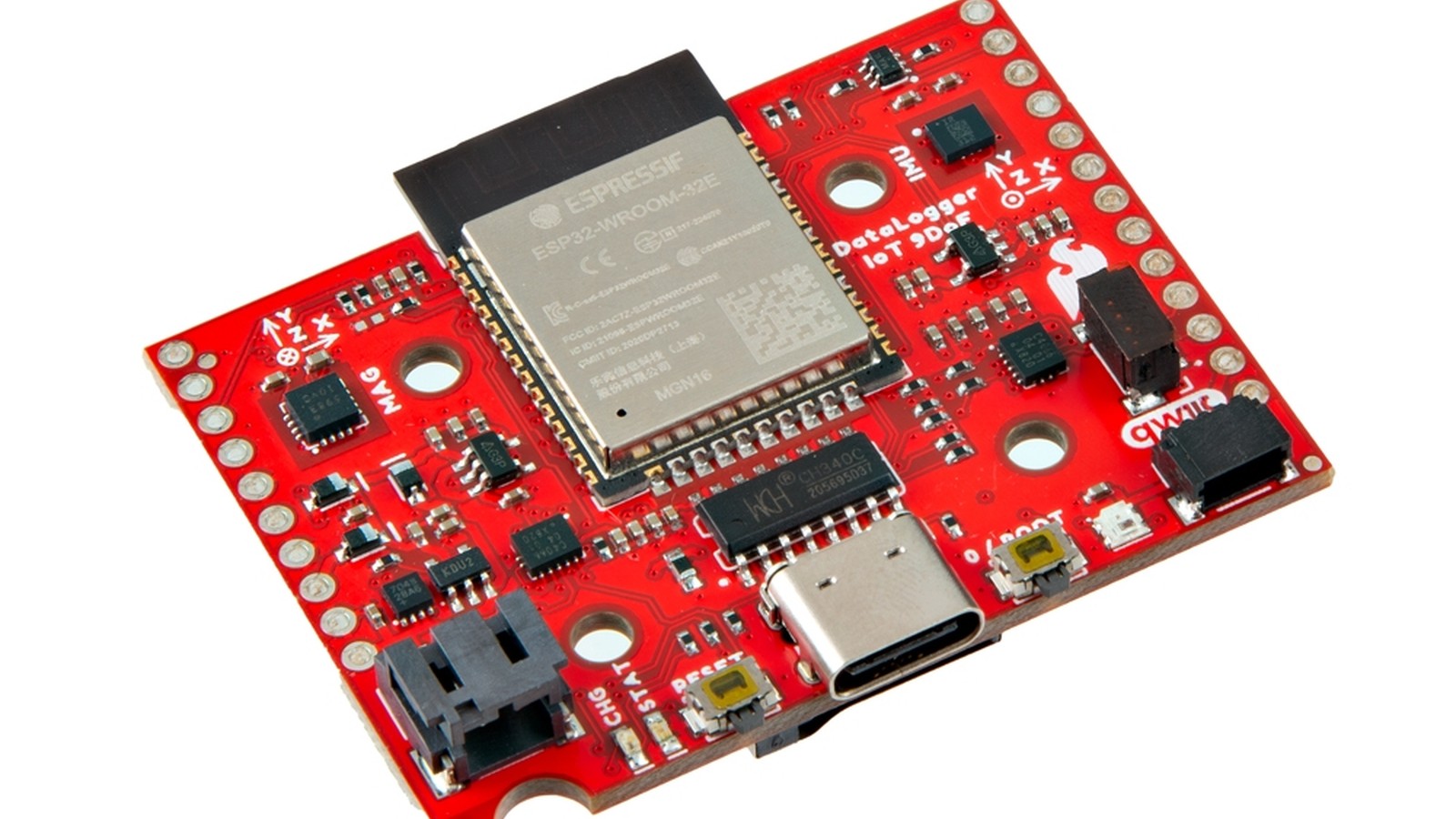
SparkFun's DataLogger IoT 9DoF arrived in May 2023 with an unusually friendly promise: connect supported sensors, switch it on, and start collecting data without writing a program. The board automatically detects devices on SparkFun's Qwiic bus, creates timestamped records, and saves them to a microSD card. It can also forward readings to supported online services over Wi-Fi.
That workflow targets the awkward gap between a handheld instrument and a custom embedded system. Many experiments need several synchronized sensor readings, but the person running the experiment may not want to build firmware, storage handling, networking, and a configuration interface first.
Qwiic makes sensor discovery practical
Qwiic is SparkFun's connector system for I2C, a common two-wire digital bus. The keyed four-pin cable carries power, ground, clock, and data, reducing the chance of reversed connections and eliminating loose breadboard jumpers. Multiple boards can share the same bus when their addresses do not conflict.
The DataLogger IoT uses that predictable hardware interface to identify supported sensors and apply known configurations. Instead of finding a library, selecting pins, opening a file, and formatting each row in code, a user can assemble a chain and manage it through the logger's interface.
Automatic detection is not magic. The logger needs built-in knowledge of a particular sensor and its I2C address. Two devices with the same fixed address can still collide, cable length and electrical noise still matter, and specialized settings may need adjustment. The benefit is that common combinations begin from a working baseline.
That baseline can be valuable in classrooms, laboratories, greenhouses, workshops, and quick field studies. The time saved is not only typing time. It avoids a collection of small mistakes involving units, delimiters, file handling, and initialization order.
Motion sensing is already onboard
The 9DoF model includes an STMicroelectronics ISM330DHCX accelerometer and gyroscope plus an MMC5983MA magnetometer. Nine degrees of freedom refers to three axes each of acceleration, angular rotation, and magnetic-field measurement. Together, those channels can describe movement and orientation.
An accelerometer senses linear acceleration, including gravity. A gyroscope measures rotational rate. A magnetometer measures magnetic-field direction and can contribute compass information. Combining their outputs is called sensor fusion. The raw measurements remain useful on their own, but stable orientation estimates normally require mathematics that accounts for each sensor's strengths and weaknesses.
The onboard package means a logger can record its own motion while collecting external measurements. A mobile environmental rig could correlate vibration with air quality. A package study could compare impacts, rotation, temperature, and humidity. A machine-monitoring trial could log movement beside current or sound.
Magnetometers are sensitive to nearby steel, motors, magnets, and current-carrying wires. Accelerometers also record gravity and mounting vibration. Users should calibrate the system in its final physical arrangement and document the board's orientation. A technically correct data file is not automatically a meaningful experiment.
Local files remain the dependable core
The logger can write CSV or JSON data to microSD. CSV stores rows of separated values and opens easily in spreadsheet and analysis tools. JSON preserves names and structure more explicitly, which can help software pipelines but creates larger files.
Local storage still earns its keep when a project has Wi-Fi. A network may be unavailable, an online service may reject a request, or credentials may expire. The card provides a direct record that can be retrieved without depending on the cloud path.
Storage needs operational planning. Estimate the record size and sampling interval, then calculate daily use with margin. Fast sampling can fill a card surprisingly quickly, especially with many channels or verbose JSON. Use reliable media, shut the logger down cleanly when possible, and inspect files during a trial rather than waiting until the end of a month-long run.
The release supported timestamps from network time, GNSS, or a real-time clock. Network Time Protocol, usually shortened to NTP, obtains time over a network. GNSS receivers can supply time from satellites. A real-time clock keeps time locally, commonly with backup power. The best option depends on where the logger operates and how precisely multiple devices must align.
Time zones and daylight-saving changes can damage otherwise good datasets. Recording in Coordinated Universal Time and converting for display later is usually safer. Also record the sampling interval and any clock source change in project notes.
Wi-Fi turns a logger into an IoT node
Sending readings online can support dashboards, alerts, and remote checks. A greenhouse operator may want to know that logging continues without visiting the site. A laboratory team may watch a long test from another room. A teacher can let a class compare live measurements from multiple locations.
The word IoT, or Internet of Things, covers this connection between physical measurements and network services. Connectivity is useful, but it increases setup and maintenance. Wi-Fi credentials must be stored, certificates and endpoints can change, and a remote service introduces privacy and retention questions.
Decide which data actually needs to leave the device. A local high-rate file and a slower online summary often make more sense than uploading every sample. This reduces bandwidth, cloud storage, and the consequences of a temporary outage.
Any alert should be tested end to end. A threshold in a dashboard is only helpful if the sensor remains calibrated, the logger is powered, the network works, and someone receives the notification. Add a heartbeat or last-seen indicator so silence is not mistaken for a normal reading.
Building a reliable first experiment
Begin with one supported Qwiic sensor and the microSD card. Confirm that the device appears, units are understood, and timestamps are correct. Let it run long enough to cross the conditions that matter, such as a day-night cycle or a machine start and stop.
Add sensors gradually. Label cables and record each model and address. If readings become erratic, shorten the Qwiic chain, reduce bus speed where supported, and separate sensor wiring from motors or power converters. Secure connectors before moving a rig into the field.
Choose a sampling rate based on the phenomenon. Room temperature changes slowly, while vibration changes quickly. Sampling a slow process thousands of times per second creates a large file without adding useful detail. Sampling a fast process once a minute can miss the entire event.
Validate readings against a known reference when possible. Check for impossible values, sudden offsets, and missing intervals. Configuration without code lowers the entry barrier, but measurement quality still depends on sensor placement, calibration, and experimental design.
Why the no-code approach matters
SparkFun did not remove programming from every possible logging project. It removed programming from the common first mile: discovering supported sensors, creating structured records, attaching time, saving locally, and connecting selected services.
That changes who can begin collecting useful data. A biologist, student, technician, or designer can test an idea before recruiting a firmware developer. Experienced makers can use the same board for rapid surveys and reserve custom code for the parts that truly require it.
The DataLogger IoT 9DoF is therefore less about avoiding code as a principle and more about shortening the path from a question to evidence. For many sensor projects, that is exactly the right optimization.
I'd start with one Qwiic sensor and the microSD card, check the timestamps, and only then add more. Most logging mistakes show up in the first hour.
Sources and image credits
- SparkFun DataLogger IoT - 9DoF, SparkFun Electronics.
- Meet the DataLogger IoT - 9DoF, SparkFun news.
- Official product image from SparkFun Electronics.
- Square and vertical crops are edited from the same source image.