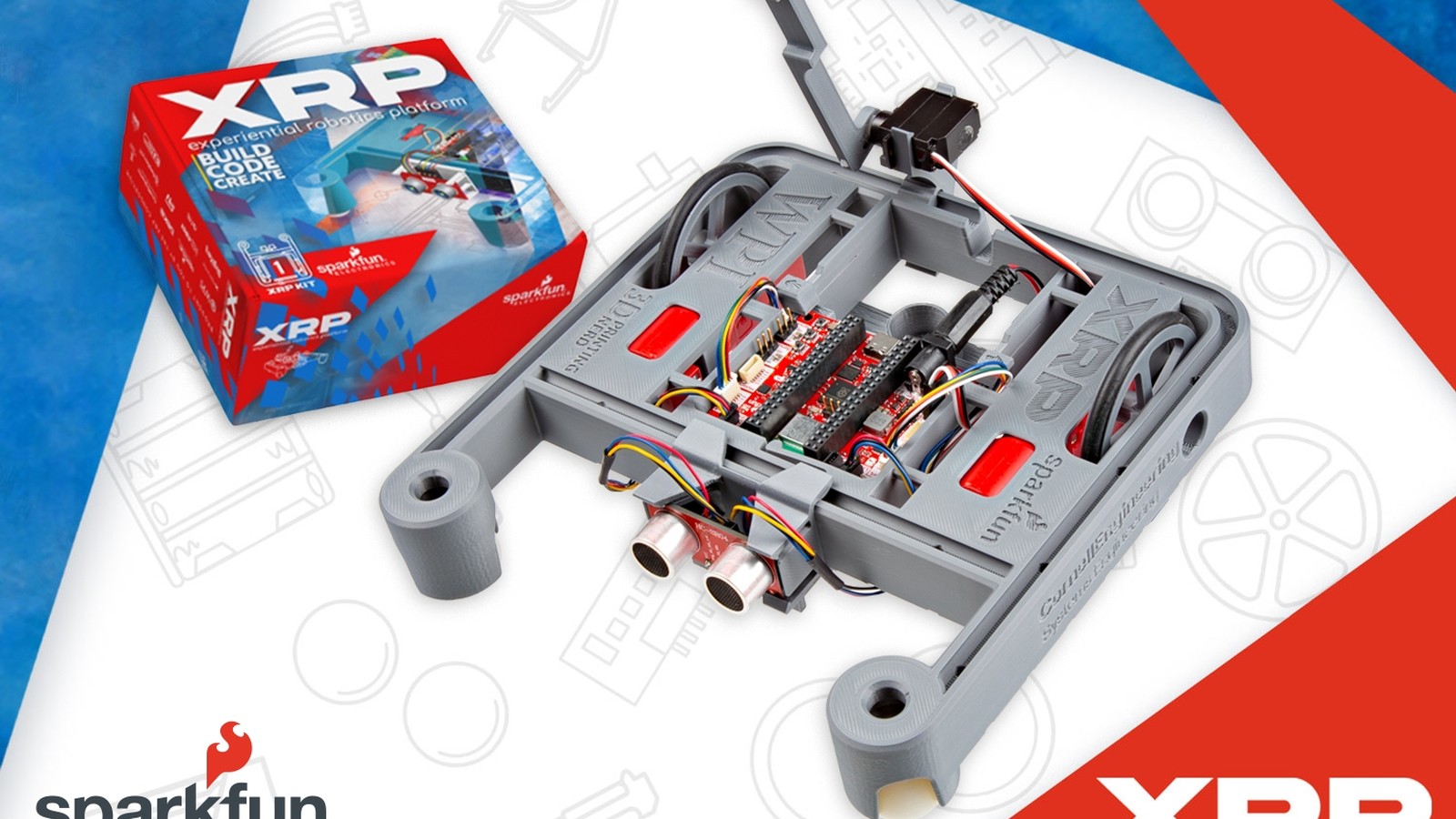
SparkFun introduced the beta version of its Experiential Robotics Platform, or XRP, in 2023 as a complete route into classroom robotics for STEM, meaning science, technology, engineering, and math, education. Developed with education and FIRST Robotics use in mind, the kit combined a Raspberry Pi Pico W-based controller, a compact chassis, motors with encoders, distance and line sensors, and guided learning materials. FIRST, short for For Inspiration and Recognition of Science and Technology, is the nonprofit that runs FIRST Robotics Competition events, where student teams design, build, and drive their own robots against the clock and against each other.
The key word was platform. XRP was intended to support a progression from a first block-based program to text coding and competition-style robot control. Students could assemble a real moving system, observe how software changes physical behavior, and then keep extending the same machine.
One kit covers the basic robot stack
A classroom robot needs more than a microcontroller. It needs a chassis, power, motor drivers, wheels, sensors, mechanical mounting, and software that exposes those parts coherently. Gathering them separately can consume teaching time before the first lesson begins.
The 2023 XRP beta integrated that stack around a controller using the Raspberry Pi RP2040 microcontroller found on the Pico W. The RP2040 provides two Arm Cortex-M0+ processor cores and programmable I/O blocks, while the Pico W adds wireless networking. SparkFun's controller connected the processor to the robot's motors, sensors, servo outputs, and expansion interfaces.
Two geared motors drove the wheels. Encoders reported wheel rotation, giving software feedback rather than leaving it to guess how far each motor traveled. An ultrasonic distance sensor measured the time taken for a sound pulse to reflect from an object. A line sensor detected contrast beneath the robot for path-following exercises. Servo connections allowed controlled movement of an added mechanism.
Encoders turn motion into a measurable problem
Applying the same power to two motors rarely produces perfectly straight travel. Manufacturing tolerances, battery voltage, floor friction, and weight distribution all affect speed. Encoders let the program count rotation and correct the difference.
This creates a natural introduction to feedback control. In an open-loop command, the program sets motor power and hopes for the expected result. In a closed-loop system, it measures the result and adjusts the command. Even a simple correction based on left and right encoder counts demonstrates the principle.
Students can measure counts per wheel revolution, calculate wheel circumference, and estimate distance. They can then compare calculated travel with a ruler measurement and investigate error. Wheel slip, carpet, turns, and battery condition make the lesson concrete.
More advanced work can introduce proportional control, where correction grows with the measured error. A proportional-integral-derivative controller, usually called PID, adds terms for accumulated and changing error. XRP gives those ideas a visible outcome: the robot either follows the intended route or it does not.
Sensors connect code to the room
The forward-facing ultrasonic sensor supports obstacle detection and distance control. Students can program the robot to stop before a wall, maintain a gap, or navigate between objects. Soft materials and angled surfaces may reflect sound poorly, which opens a useful discussion about sensor limitations.
The downward line sensor supports following taped paths or detecting boundaries. Threshold selection is part of the experiment. A value that separates black tape from a white mat under classroom lighting may fail on a glossy floor or in sunlight. Calibration should be treated as an expected step rather than evidence that the sensor is defective.
Together, distance, line, and encoder measurements show that robots do not perceive the world as people do. They receive limited numerical signals. Good behavior comes from choosing useful measurements, handling ambiguity, and testing in the real environment.
The Qwiic connection extended the sensor choices. Because Qwiic uses keyed I2C cables, a class could add compatible devices without soldering. Address conflicts and bus limits still apply, but the connector system makes experimentation more approachable.
A progression from blocks to robot frameworks
SparkFun positioned XRP for several programming routes, including Blockly-style visual coding and MicroPython. Block coding lets beginners arrange actions and logic without syntax errors. MicroPython exposes the same concepts as readable text, providing a bridge toward conventional programming.
The platform was also connected to Arduino and WPILib workflows. Arduino is familiar across the maker community. WPILib is the software library widely used in FIRST Robotics Competition, so exposure can prepare students for larger team robots. That bridge helps FIRST teams directly. The competition robots students build in high school run on WPILib code, so a student who has already used it on an XRP is not starting from zero when they join a team.
The important teaching choice is not which language is universally best. It is whether the tools let students understand inputs, decisions, and outputs. A line-following program has the same core loop in blocks or text: read sensors, compare values, adjust motors, and repeat.
Instructors can begin with direct commands, then introduce functions, variables, conditionals, and loops as the robot needs them. Logging sensor values before writing autonomous behavior helps students see what the hardware sees. That habit also makes debugging less mysterious.
Classroom hardware needs operational planning
A useful education kit must survive repeated assembly and mistakes. Teachers should number robots, battery packs, and storage bins, then keep a known-good firmware image and a short checkout routine. Before a session, verify wheel movement, encoder counts, sensor readings, and cable condition.
Battery state is a common source of inconsistent behavior. Motors may slow or reset the controller when the supply sags. Charging and storage procedures should be part of the lab plan, not an afterthought. Students should know how to stop a robot quickly if code sends it in an unexpected direction.
Mechanical consistency helps too. Loose wheels, reversed motor leads, and sensors mounted at different heights can make identical programs behave differently. Some variation is educational, but invisible setup errors can frustrate beginners. Establish a baseline configuration before inviting modifications.
Wireless features should follow school network policy. Many core robotics lessons can run without internet access. If browser tools or Wi-Fi communication are used, test them on the actual managed network before class and keep an offline route available.
A practical sequence of lessons
Start with assembly and identification. Students should locate the controller, motor outputs, encoders, distance sensor, line sensor, and power switch. Then run each subsystem independently.
The first motion program can drive forward briefly and stop. The next can use encoder counts to travel a measured distance. Add turning, then compare several turn strategies. Once motion is repeatable, inspect raw line-sensor readings over light and dark surfaces and build a basic follower.
Obstacle exercises can begin with a simple stop distance and develop into state machines. A state machine represents behavior as named modes, such as searching, driving, avoiding, and stopped. This structure scales better than a growing pile of delays and nested conditions.
Finally, give students a challenge with several valid solutions. A course that includes a line, an obstacle, and an object to move encourages teams to combine sensing, control, and mechanical changes. Require a short test log so iteration becomes part of the result.
Why XRP is a meaningful launch
The XRP beta joins accessible hardware with a learning path that can grow. Beginners get a robot that can move and sense without a custom parts hunt. More experienced students can explore feedback, autonomy, wireless communication, and competition-oriented tools.
That continuity is valuable in STEM programs. The robot provides immediate satisfaction, but it does not have to become disposable once the first lesson is complete. By connecting simple experiments to the same control ideas used in larger machines, SparkFun and its partners give students a platform for learning how robots actually work.
If you're a teacher or mentor, I'd keep numbered robots, charged batteries, and a known-good firmware image ready before the first class. It keeps the lessons about robotics rather than setup.
Sources and image credits
- Experiential Robotics Platform (XRP) Kit - Beta, SparkFun Electronics.
- Announcing the Experiential Robotics Platform (XRP) Kit, SparkFun news.
- Official product image from SparkFun Electronics.
- Square and vertical crops are edited from the same source image.