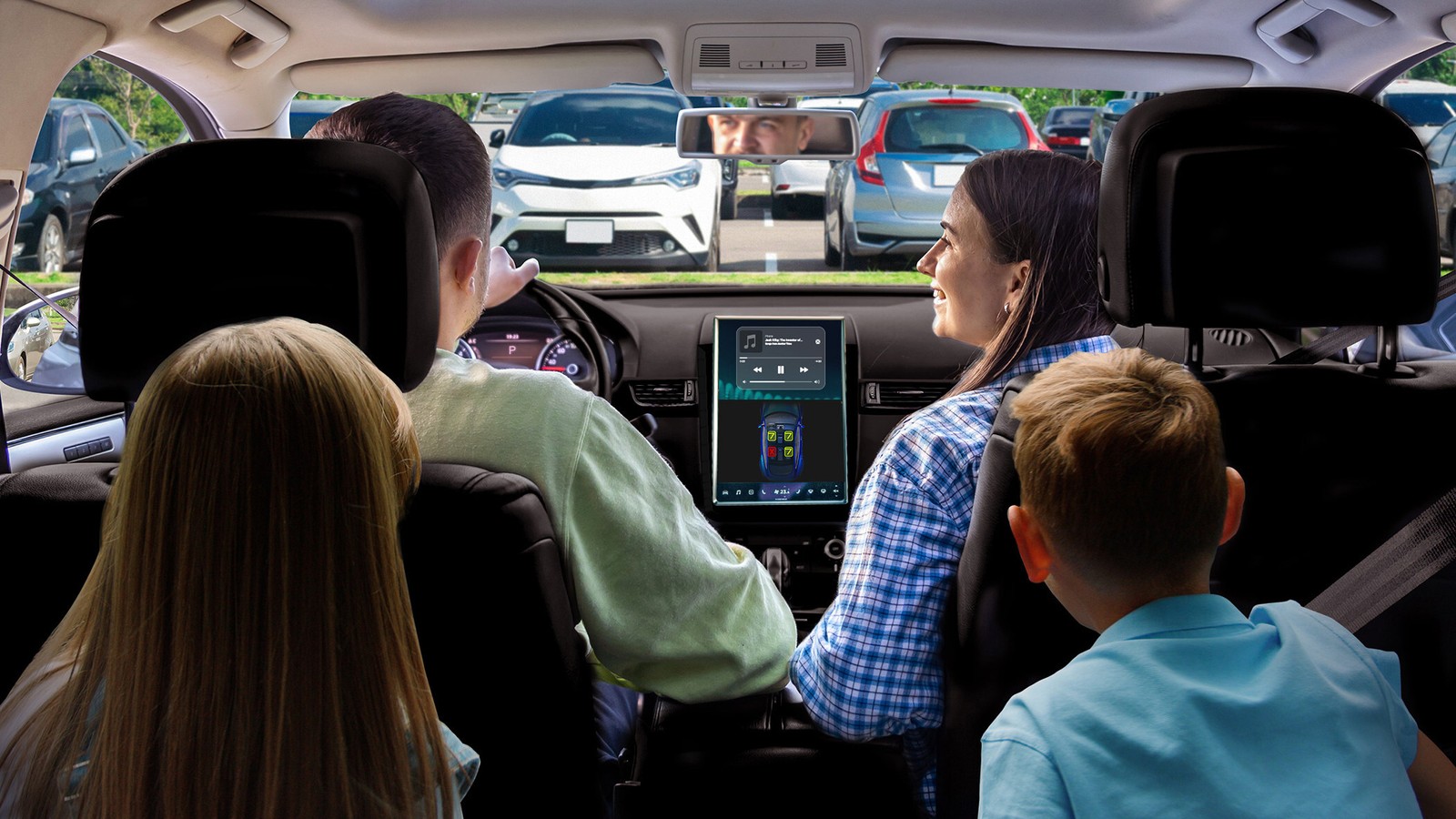
Texas Instruments introduced the AWRL6844 on January 6, 2025, as a 60GHz millimeter-wave radar sensor with enough on-chip processing to run artificial intelligence models at the edge. The company designed it for in-cabin automotive sensing, including occupant monitoring, child-presence detection, and intrusion detection.
That list of features may make the device sound like three separate sensors bundled into one product. The more interesting point is that one radar can collect fine motion and position data, then classify what it sees without sending every raw sample to a distant processor. TI combines four transmitters, four receivers, a hardware accelerator, and a digital signal processor in one device.
The AWRL6844 is not a plug-and-play maker module, and automotive safety work demands far more validation than a weekend project. Even so, its architecture is a useful signpost. Radar is moving beyond simple distance measurement and toward local interpretation of complex scenes.
What a 60GHz radar can detect
Millimeter-wave radar transmits radio energy and measures the reflections. From those reflections, a system can estimate range, relative motion, and direction. At 60GHz, the wavelength is about five millimeters, which makes it possible to detect movements much smaller than a person walking across a room.
That sensitivity is why radar can recognize breathing and other subtle motion without producing a conventional photograph. It also works in darkness and can be placed behind some nonmetallic trim materials. For a vehicle cabin, those properties are useful because the sensor must operate during the day, at night, and across a wide range of clothing and interior conditions.
The AWRL6844 uses four transmitting and four receiving channels. Multiple channels let the system compare signals arriving along different paths and estimate where reflections originated. More antenna channels do not automatically produce a perfect three-dimensional map, but they give the processing pipeline richer spatial information than a single transmitter and receiver could provide.
Edge AI changes the division of labor
In an ordinary sensing system, a small front-end device may gather data and forward it to a larger computer. Edge AI moves at least part of the inference process close to the sensor. Inference is the step where a trained model evaluates new measurements and produces a classification or estimate.
TI equipped the AWRL6844 with a radar hardware accelerator and a digital signal processor. The accelerator handles repeated signal-processing operations efficiently, while the programmable processor can run algorithms and machine-learning workloads. Keeping those jobs on the sensor can reduce the volume of data sent across the vehicle network and shorten the path between measurement and response.
There is also a privacy advantage. Radar data does not resemble a recognizable color image of a passenger. This doesn't make the system automatically anonymous or secure, but it gives designers a sensing option that can answer questions about position and motion without installing another camera in the cabin.
Edge processing has costs. Models must fit within the device's memory and compute budget, and developers must validate them against the real environments in which they will operate. A model that performs well in a controlled demonstration may behave differently with unusual seating positions, loose objects, thick blankets, vibration, or radio reflections from interior materials.
One sensor, three cabin jobs
TI highlighted occupant monitoring as the first major use. A vehicle needs to know which seats are occupied and, in more advanced systems, where each person is sitting. This kind of information can help control seat-belt reminders, airbag behavior, and other cabin functions.
The company said its algorithms could achieve 98 percent occupant localization accuracy. It also reported more than 90 percent classification accuracy for child micromovements. Those are TI's stated results, not a guarantee for every installation. Radar placement, cabin geometry, software configuration, and the evaluation data set all affect real-world performance.
Child-presence detection is especially demanding because a sleeping infant may produce only very small movements. A radar system can look for respiration-scale motion even when a child is covered or the cabin is dark. The task is not merely to detect any reflection. The software must separate meaningful motion from vibration, ventilation, moving fabric, and other clutter.
Intrusion detection uses the same basic sensing chain differently. Instead of locating authorized occupants during a drive, the system watches for movement in a parked vehicle. The value of combining these functions is not that they run identically, but that automakers may be able to reuse the same installed radar hardware for several software-defined features.
Why the single-chip approach matters
Every additional electronic module adds cost, wiring, mounting requirements, power demand, and another potential point of failure. Integrating the radio and processing into one sensor does not eliminate the need for antennas, power regulation, communications, and careful mechanical design. It does reduce the number of major processing components required near the sensing position.
TI also positioned the sensor as a way to cover more of the cabin with fewer devices. A four-transmitter, four-receiver arrangement can support a wider and more detailed field of view, although the final coverage depends heavily on the antenna design and where the module is mounted.
This is a recurring theme in embedded electronics: integration makes the bill of materials shorter, but it does not make system engineering disappear. Radar at 60GHz is sensitive to board layout, antenna geometry, plastics, metal structures, and manufacturing tolerances. Developers generally start with an evaluation module and the vendor's reference design rather than treating the sensor like a low-frequency breakout board.
What it means beyond the automotive cabin
The AWRL6844 targets vehicles, so it should not be mistaken for the simplest route to a hobby presence detector. Automotive parts, development tools, and qualification requirements can make experimentation expensive. Still, the capabilities map neatly onto problems in robotics and smart spaces.
A mobile robot could use similar radar processing to distinguish an occupied area from an empty one without relying on light. A room sensor could detect fine motion when a person is sitting still. An access system could watch for movement behind an opaque plastic cover. Health and assisted-living researchers may also be interested in contactless motion data, subject to appropriate safety, privacy, and regulatory controls.
For makers, the immediate lesson is less about buying this exact chip and more about how to evaluate the growing number of radar modules that will follow. Check whether a module exposes raw radar data, processed point clouds, or only a final presence flag. Look for antenna coverage, minimum and maximum range, update rate, power draw, software support, and the ability to tune detection zones. Those details often matter more than the headline frequency.
Radar AI still needs careful validation
Adding AI does not turn a sensor into an infallible observer. Machine-learning output is probabilistic, and the physical measurement can be disturbed before the model sees it. A responsible design needs test cases for normal use, edge cases, installation variation, interference, and failure modes.
Automotive systems add another layer because sensing results may influence safety-related behavior. Production designs need the appropriate functional-safety process, cybersecurity planning, environmental qualification, and regulatory review. TI's announcement describes the enabling component, not a complete certified child-presence or occupant-monitoring system.
The AWRL6844 nevertheless marks a clear shift. A compact radar sensor can now do more than report distance or motion. It can process a multidimensional reflection pattern locally and help decide what kind of activity is occurring. As evaluation hardware and software improve, that same pattern will make sophisticated contactless sensing more accessible well beyond the vehicle cabin.
You won't be dropping this chip on a breadboard, but I find it a useful preview of where cheap presence sensing is heading. When you shop for radar modules, check whether they give you raw data or only a yes-or-no flag.
Sources and image credits
- New Edge AI-Enabled Radar Sensor and Automotive Audio Processors From TI Empower Automakers To Reimagine In-Cabin Experiences, Texas Instruments, January 6, 2025.
- AWRL6844 60GHz edge AI radar sensor image, Texas Instruments, January 6, 2025.
- Square and vertical crops are edited from the same source image.