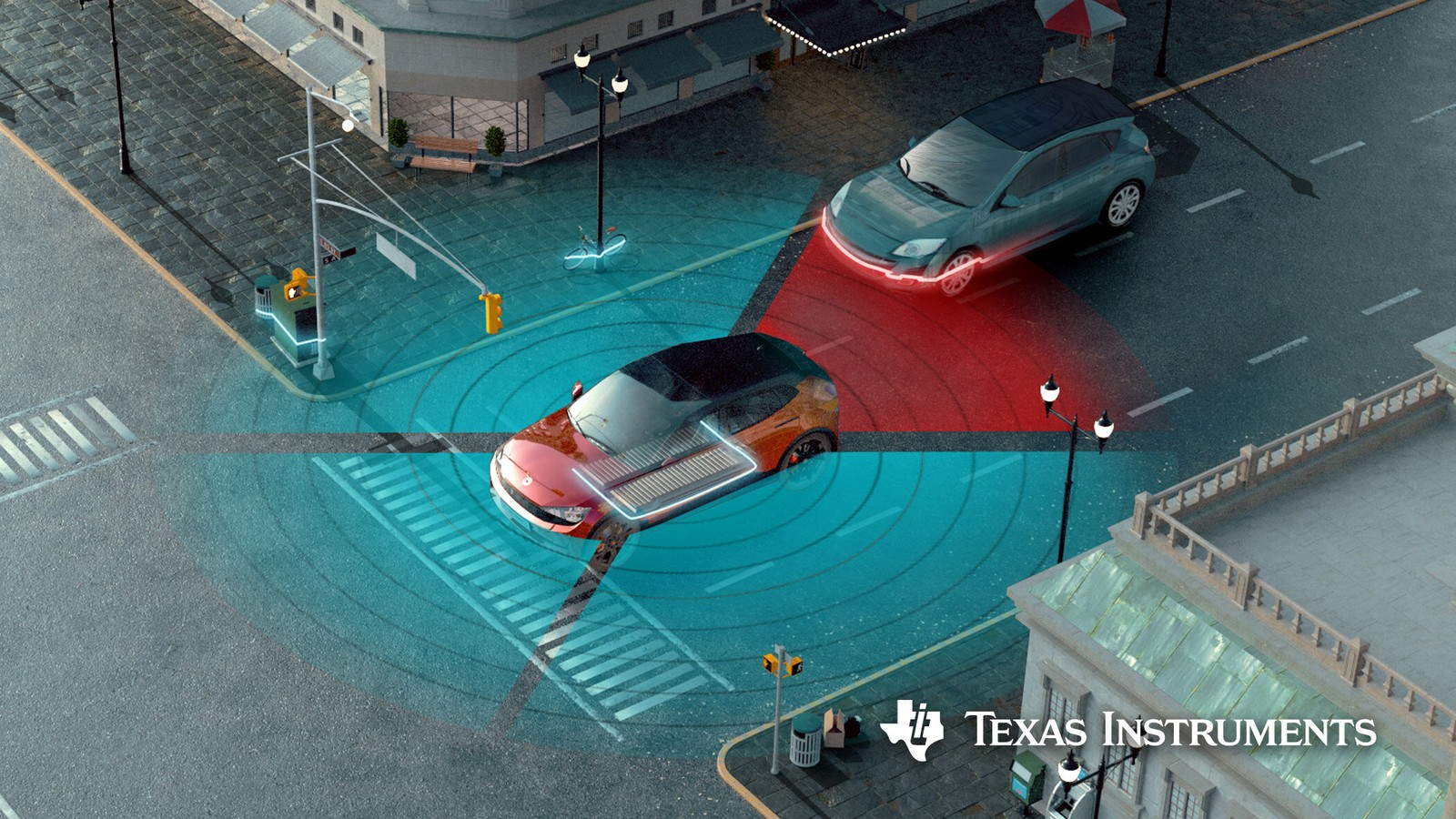
Texas Instruments introduced the AWR2544 at CES (the Consumer Electronics Show, a major annual trade show for new hardware) on January 8, 2024, as a single-chip 77GHz millimeter-wave radar sensor designed for satellite radar architectures. TI said the device could support sensing beyond 200 meters while a launch-on-package antenna arrangement could reduce radar-module size by as much as 30 percent.
The target is automotive advanced driver-assistance systems, not a casual distance sensor. Still, the architecture is worth understanding because compact mmWave radar is spreading into robotics, industrial monitoring, building automation, and contactless presence detection.
Millimeter-wave radar transmits radio energy, measures reflections, and extracts properties such as range, relative velocity, and direction. Unlike a camera, it does not depend on visible light. Unlike a simple ultrasonic sensor, it can resolve motion and multiple targets at much greater distances under the right conditions.
What satellite radar means
A traditional smart radar module may perform most signal processing and object detection locally, then send a compact object list to the vehicle. A satellite radar architecture moves more of the higher-level processing to a central computer.
The AWR2544 performs radio and initial processing near the antenna, then provides semi-processed data for centralized sensor fusion. Sensor fusion combines information from several radars and potentially cameras, lidar, or other sources to create a more complete view around the vehicle.
Centralization can let the system compare richer data across multiple sensor positions. It can also reduce duplicated processing in every satellite. The tradeoff is a demanding data network and a central processor that must handle large, time-sensitive streams reliably.
Launch-on-package changes the antenna layout
TI called the AWR2544 the first radar sensor with launch-on-package technology. In this design, the radio-frequency signal leaves the chip package through a controlled structure and reaches a three-dimensional waveguide antenna mounted on the opposite side of the printed circuit board.
This approach can shrink the sensor because the antenna assembly no longer consumes the same board area beside the processing electronics. TI claimed a module-size reduction of up to 30 percent and range beyond 200 meters with one chip.
At 77GHz, ordinary PCB (printed circuit board) habits are not enough. Traces, transitions, board materials, mechanical tolerances, enclosure geometry, and antenna alignment all affect performance. Evaluation hardware and reference designs are valuable because they demonstrate a validated radio-frequency structure.
Range is only one radar metric
A long detection range helps a vehicle react earlier, but it does not describe the full sensing problem. Angular resolution determines whether nearby objects can be separated. Range resolution distinguishes targets at similar distances. Velocity resolution separates their relative motion. Field of view and update rate affect coverage and response.
Radar performance also changes with target size, material, orientation, weather, mounting, and interference. A large vehicle reflects much more energy than a small object. A quoted maximum range should never be treated as guaranteed detection for every target.
Advanced driver-assistance systems therefore use controlled requirements and extensive validation. The sensor must operate across temperature, vibration, contamination, and manufacturing variation, then fail predictably when conditions exceed its limits.
Why centralized processing can improve decisions
A vehicle may place radar units at the front, rear, corners, and sides. If each sensor reduces its measurements to an object list independently, some information is discarded before the central computer compares views.
Satellite sensors can preserve more intermediate information. A central processor can combine overlapping observations, track an object across sensor zones, and apply a shared perception model. TI positioned this as a route toward more accurate decision-making and higher levels of automation.
The architecture resembles distributed sensing elsewhere. A robot can place lightweight sensor heads around its frame while a central computer performs mapping. A building can collect radar data from several rooms for occupancy analysis. Automotive bandwidth and safety requirements are far stricter, but the system pattern is transferable.
What makers should understand
The AWR2544 itself is an automotive component, and developing a 77GHz radar module is not a breadboard project. Millimeter-wave signals require specialized layout, fabrication, measurement equipment, and regulatory awareness. TI offered evaluation modules so engineers could begin from known hardware.
For experimentation, use an evaluation kit and the supported software chain. Start with recorded or visualized range data before attempting custom object classification. Learn the difference between raw analog-to-digital samples, range-Doppler maps, point clouds, and tracked objects.
A range-Doppler map arranges reflected energy by distance and relative velocity. A point cloud represents detections as coordinates and attributes. Object tracking groups measurements over time. Each stage removes data and adds assumptions, so debugging is easier when intermediate results can be inspected.
Radar is not a privacy-free camera replacement
Radar does not produce a normal photograph, which can reduce some privacy concerns. It can still reveal presence, movement, breathing patterns, and behavior. Deployments need clear policies for retention, access, and user consent.
Safety claims also require restraint. A radar sensor contributes measurements, but the complete system determines whether a vehicle responds correctly. Mounting, calibration, software, networking, fusion, braking, diagnostics, and redundancy are all part of the safety case.
Evaluation should include difficult scenes, not only an open-road demonstration. Nearby guardrails, rain, large vehicles, road surfaces, and reflections from the vehicle itself can all change what the receiver sees. Engineers characterize false detections as carefully as maximum range because a sensor that reports too many questionable targets can burden the central processor or cause unstable tracking. Raw sensitivity and useful perception are related, but they are not the same metric.
The high-speed link is another design boundary. Satellite radar shifts work toward the central computer, so bandwidth, synchronization, latency, and packet loss become part of sensing performance. A compact remote module is only successful when the network delivers its data predictably and the central software can combine measurements from several positions in time.
The AWR2544 announcement is notable because it shows where radar systems are heading: smaller satellite modules feeding powerful central processors. Launch-on-package technology addresses physical size, while richer centralized data aims to improve perception. For makers and embedded developers, the useful lesson is architectural. Modern sensing is increasingly distributed at the edge but interpreted as one coordinated system.
I'd read this as a lesson in how sensing systems are organized rather than as a buying guide, since the chip itself is an automotive part.
Sources and image credits
- TI Debuts New Automotive Chips at CES, Enabling Automakers To Create Smarter, Safer Vehicles, Texas Instruments, January 8, 2024.
- AWR2544 CES graphic, Texas Instruments, January 8, 2024.
- Square and vertical crops are edited from the same source image.