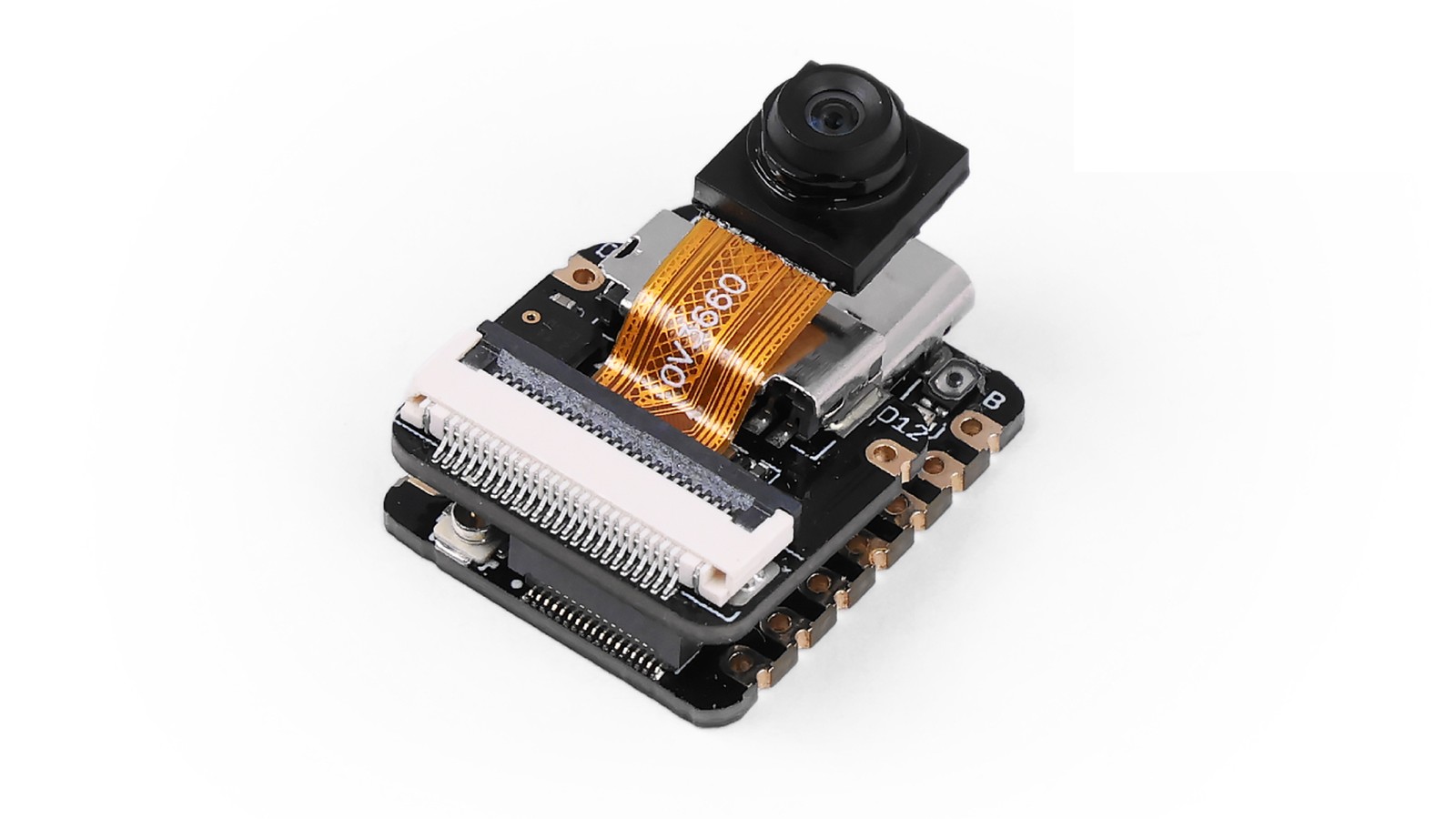
Seeed Studio's XIAO ESP32-S3 and XIAO ESP32-S3 Sense brought Espressif's capable ESP32-S3 into the company's thumb-sized development-board format in early 2023. The standard board combined Wi-Fi, Bluetooth Low Energy, USB, battery support, and a dual-core processor. The Sense version added an expansion board with a camera and digital microphone, creating an unusually compact platform for vision, voice, and wearable machine-learning projects.
The launch showed how far small microcontroller boards had moved beyond blinking LEDs. An ESP32-S3 can accelerate common vector operations used in signal processing and neural networks, while still behaving like an approachable Arduino-compatible controller.
The challenge was physical integration. Seeed described a 30-pin board-to-board connector with 0.4mm pin spacing and manufacturing pad gaps down to 0.2mm. Those details explain how the Sense expansion fits without making the base XIAO footprint larger.
What the ESP32-S3 contributes
The ESP32-S3 uses two Xtensa LX7 processor cores running at up to 240MHz. It supports 2.4GHz Wi-Fi and Bluetooth Low Energy, giving one board both local network connectivity and direct links to phones or nearby sensors.
Espressif added vector instructions that speed up repeated arithmetic used in neural-network inference and digital signal processing. This does not turn the microcontroller into a desktop GPU. It does make small classifiers, wake-word detectors, anomaly models, and low-resolution vision networks more practical at the edge.
TinyML is the practice of running machine-learning inference on constrained embedded hardware. A model is trained elsewhere, converted into a compact format, and executed on the device. Keeping inference local can reduce latency, bandwidth, and cloud dependence.
Memory remains the key constraint. Camera frames, audio buffers, wireless stacks, and model weights all compete for RAM. Developers should choose image size and model architecture together rather than building a model first and hoping it fits later.
The Sense board adds eyes and ears
The XIAO ESP32-S3 Sense uses a small stacked expansion board for its camera and microphone. The camera supports embedded vision experiments such as object classification, presence detection, gesture recognition, and time-lapse capture. The microphone enables sound classification, voice activity detection, and simple speech interfaces.
Combining the two sensors on a removable board is useful. A project can prototype with vision and audio, then omit the expansion when the final product only needs the base controller. The connector also preserves the small outline instead of placing a large sensor header beside the XIAO.
Camera projects expose the limits quickly. Higher resolution produces more pixels to store and process. Frame rate increases CPU, memory, and power demand. Good lighting and a fixed scene can improve results more than a larger model.
Microphone inference has similar tradeoffs. Audio is normally divided into short windows, converted into compact frequency features, and passed to a classifier. The system must distinguish the target sound from fans, handling noise, echoes, and conversation. Record training and test samples in the intended enclosure because the case changes the acoustic response.
Tiny hardware creates real engineering constraints
Shrinking a board is not simply a matter of moving components closer. Power integrity, radio clearance, heat, routing, connector strength, and assembly tolerance all become harder.
Seeed said its engineers removed redundant capacitors only after reviewing the power design and adjusted other components to control risk. It also selected smaller oscillators and a smaller diode after testing alternatives. These are ordinary but important engineering decisions: every saved square millimeter must preserve electrical performance and manufacturability.
The fine-pitch board-to-board connector was produced with high-precision surface-mount assembly. Makers do not need to solder those 0.4mm contacts themselves, but the density affects mechanical handling. Stacked boards should be aligned carefully, and a wearable enclosure should support the assembly rather than letting the connector absorb repeated bending.
The onboard radio also needs space. Batteries, metal cases, displays, and the user's body can detune or shield an antenna. Test Wi-Fi and Bluetooth range in the final orientation, especially for wearables where a bench result can be misleading.
Why the XIAO form factor is useful
The XIAO family uses a consistent small outline and castellated edge pads. Castellations are plated half holes that can accept headers for breadboard work or be soldered directly onto a carrier PCB. That makes the same board useful for experiments and low-volume embedded products.
USB-C simplifies programming and power during development. Battery connections support portable projects, though developers must confirm the exact charging behavior and protect the cell mechanically. Pins expose common digital, analog, and serial interfaces for sensors and actuators.
The limited number of pins forces sensible planning. A camera, microphone, display, storage device, and several sensors may compete for interfaces. Check the pin map, reserved connections, and peripheral routing before designing a carrier board.
For production, decide whether a complete XIAO module or a custom ESP32-S3 board makes more sense. The module reduces RF and assembly work at modest volumes. A custom design can lower unit cost and optimize shape at scale, but it transfers antenna, certification, and manufacturing risk to the product team.
A practical TinyML workflow
Start with a small, clearly defined classification problem. For vision, distinguish a few objects under controlled lighting before attempting general detection. For audio, collect the target sound plus realistic background noise and silence.
Train the model on a computer or managed TinyML platform, then quantize it to an embedded-friendly representation. Quantization reduces numerical precision, often to 8-bit integers, which cuts memory and computation. Compare accuracy before and after conversion.
Deploy a minimal inference example before adding Wi-Fi dashboards or battery features. Measure flash, peak RAM, inference time, and current. If the model does not fit, reduce input size, network width, or number of classes instead of disabling safety margins.
Then collect failures from the real device. A model trained on polished sample images may fail when the camera is tilted, the lens is dirty, or daylight changes. Useful edge AI improves through representative data, not through specifications alone.
Where the board fits best
The XIAO ESP32-S3 Sense is well suited to wearable experiments, compact wildlife cameras, gesture controls, smart toys, local sound triggers, and machine monitoring. It can make an event decision locally and transmit only a result instead of continuous media.
It is not intended for large generative models or high-resolution multi-camera analytics. Projects requiring complex detection at high frame rates belong on a Linux-class edge computer such as a Jetson system. The XIAO is strongest when a small model answers a narrow question within a tight power and size budget.
The board's significance is the combination of physical scale and sensory capability. Seeed fit a powerful wireless microcontroller and optional camera and microphone into a familiar miniature ecosystem. That gave makers a practical bridge from ordinary connected sensors to devices that can interpret what they see and hear on their own.
I'd get the camera or the microphone working on its own before adding Wi-Fi, since memory runs out quickly on a board this small.
Sources and image credits
- Official Seeed Studio blog post, Seeed Studio, February 16, 2023.
- Official product image from Seeed Studio: Seeed Studio XIAO ESP32S3 Sense.
- Square and vertical crops are edited from the same source image.