A development board makes a microcontroller easy to try. A chip that anyone can buy makes it possible to build that microcontroller into a product of your own.
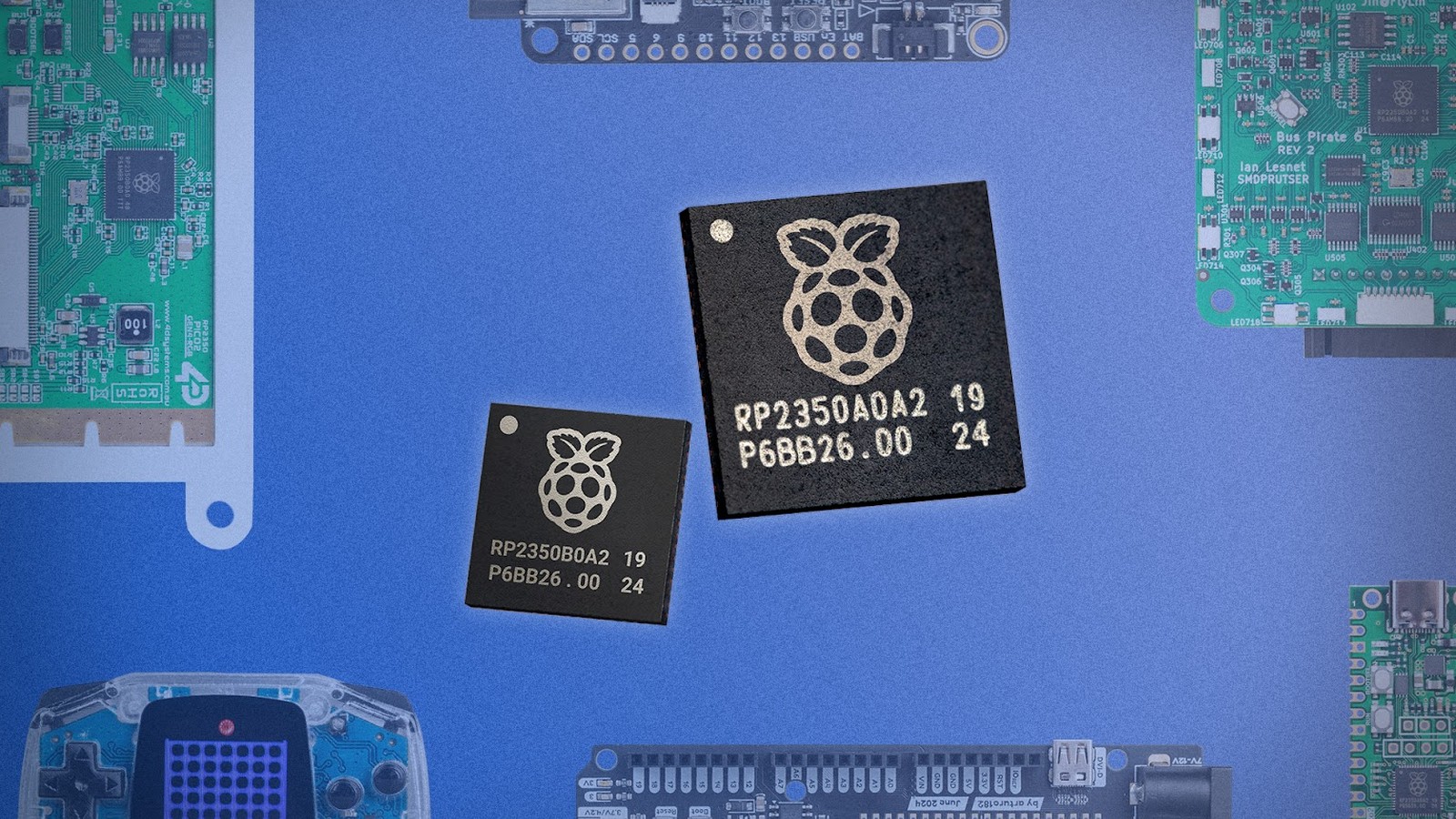
Raspberry Pi crossed that line for RP2350 on March 17, 2025, when the company made the device broadly available through its approved reseller network. RP2350 had debuted in Raspberry Pi Pico 2 and early partner boards. General component sales opened it to custom printed-circuit boards, contract assembly, and larger production runs.
The launch positioned RP2350 as a higher-performance successor to RP2040 at nearly the same volume price. It combined two Arm Cortex-M33 processor cores, generous on-chip memory, programmable I/O, and a security architecture based on Arm TrustZone.
What is inside RP2350?
The chip includes two Arm Cortex-M33 cores running at up to 150 MHz. A processor core executes program instructions. Two cores allow software to divide work, such as separating time-sensitive input handling from communication or application logic.
The Cortex-M33 includes floating-point and digital-signal-processing support. A floating-point unit accelerates calculations involving fractional values. Digital signal processing, or DSP, applies mathematical operations to sampled data such as audio, vibration, and sensor readings.
RP2350 also provides 520 KB of static random-access memory, commonly shortened to SRAM. SRAM holds the program's working data while power is present. The chip normally uses external flash memory for application storage, letting board designers choose capacity and package.
The programmable I/O subsystem, known as PIO, is one of the platform's distinctive features. PIO consists of small state machines that can generate or receive precisely timed digital signals independently of the main CPU. A state machine follows a defined sequence of states and transitions.
PIO can implement an unusual serial protocol, drive LED arrays, capture pulse timing, or offload repetitive pin activity. It does not replace every peripheral, but it gives the chip flexibility when built-in hardware does not match a project.
What security features does it provide?
RP2350 uses Arm TrustZone for Cortex-M to separate secure and non-secure software regions. The secure side can hold sensitive services and keys, while ordinary application code runs with limited access.
Secure boot verifies firmware before it runs. Signed updates help a product accept software from an authorized source. One-time-programmable memory stores permanent configuration and security data. The chip also includes protections intended to resist fault injection and other physical attacks.
These are building blocks, not automatic product security. A designer must configure keys, boot policy, debug access, memory permissions, and recovery behavior. Raspberry Pi's public hacking challenge had already identified several weaknesses and mitigations by the time broad sales began.
Always consult the current errata for the exact silicon revision. An erratum documents a known hardware issue.
What are RP2350A and RP2350B?
Raspberry Pi offered two packages. RP2350A uses a 7 by 7 millimeter QFN60 package. RP2350B uses a larger 10 by 10 millimeter QFN80 package with additional input/output pins and analog capabilities.
QFN means quad flat no-lead. Its electrical contacts sit underneath and around the edges of the package instead of extending as long legs. QFN packages are compact and perform well electrically, but they require accurate printed-circuit-board footprints and controlled soldering.
The larger B package gives board designers access to more GPIO. GPIO, or general-purpose input/output, pins connect software to buttons, sensors, displays, buses, and control signals. More pins help when a design needs a parallel interface, many channels, or fewer external expanders.
The packages are not interchangeable. A board layout must target one footprint, and firmware must use pins that exist on that variant. Begin with Raspberry Pi's hardware design documentation and verified CAD libraries rather than drawing the land pattern from memory.
How did pricing compare with RP2040?
Raspberry Pi emphasized sub-$1 volume pricing. On a large 13-inch reel, RP2350A was listed at $0.80 per device and RP2350B at $0.90. Smaller reels and single quantities cost more. The company described the increases over comparable RP2040 purchasing as ten or twenty cents, depending on package.
Reel pricing is the manufacturer's number because automated placement machines feed components from tape wound on reels. A maker buying one chip should expect a higher unit price, shipping, and distributor differences.
The microcontroller price is only part of the bill of materials. A custom RP2350 board also needs external flash, power regulation, decoupling capacitors, clock components where required, USB circuitry, connectors, and a printed circuit board. Decoupling capacitors supply short bursts of local current and reduce power-supply noise near the chip.
What changed for custom-board designers?
Before broad availability, the simplest route was a Pico 2 or partner module. Those boards remain ideal for prototypes. They include power, flash, USB, and a known-good layout. A finished product may need a different size, connector arrangement, power system, or set of exposed pins.
Buying the bare chip lets the designer remove unused development-board hardware and integrate RP2350 directly. That can reduce size and cost at volume. It also transfers responsibility for signal integrity, power sequencing, flash connections, USB layout, and manufacturing test.
Start by proving the firmware on Pico 2. Move to a reference-based custom design only after the pin requirements and interfaces are stable. Add test points for power rails, reset, programming, and important buses. A test point is an exposed pad where manufacturing or debugging equipment can make contact.
Plan the programming process before ordering boards. A blank chip needs boot flash and product firmware. Production may use USB boot, Serial Wire Debug, or a bed-of-nails fixture. Serial Wire Debug, or SWD, is Arm's two-wire programming and debugging interface. A bed-of-nails fixture uses spring-loaded probes to contact test pads on a board.
What could makers build?
RP2350 fits devices that need deterministic control and unusual interfaces without the overhead of Linux. Robotics controllers can use one core for control loops and another for communication. Audio projects can combine DSP instructions with PIO-based digital interfaces. Test equipment can generate and capture custom waveforms.
The security features make it more relevant to commercial devices that need signed firmware and protected credentials. Industrial automation and consumer electronics can use the dual-core performance without paying for an application processor and external memory.
It is not always the best choice. Wireless projects may prefer a microcontroller with Wi-Fi or Bluetooth integrated. Very low-power battery devices should compare sleep current and peripheral behavior with dedicated low-power families. Simple applications may remain cheaper and easier on RP2040.
General availability is the important milestone because it changes RP2350 from a platform found on other people's boards into a component for original designs. Raspberry Pi is pairing the chip with documentation, software support, reseller distribution, and assembly partnerships. That complete path is what helps a maker move from a breadboard prototype to a board that can be manufactured repeatedly.
My advice is to prove the firmware on a Pico 2 first, and only move to a bare-chip board once the pins and interfaces stop changing.
Sources and image credits
- Raspberry Pi announcement: RP2350 available to buy
- RP2350 product page
- RP2350 hardware documentation
- Official launch image from Raspberry Pi's news article, credited to Raspberry Pi Ltd.
- Square and vertical crops are edited from the same source image.