Matter promises that smart-home products can work across major ecosystems, but implementing a complete Matter device is not a small programming exercise. The product still needs commissioning, security, a data model, over-the-air updates, certificates, networking, and the physical logic that makes it a useful switch, sensor, light, or appliance.
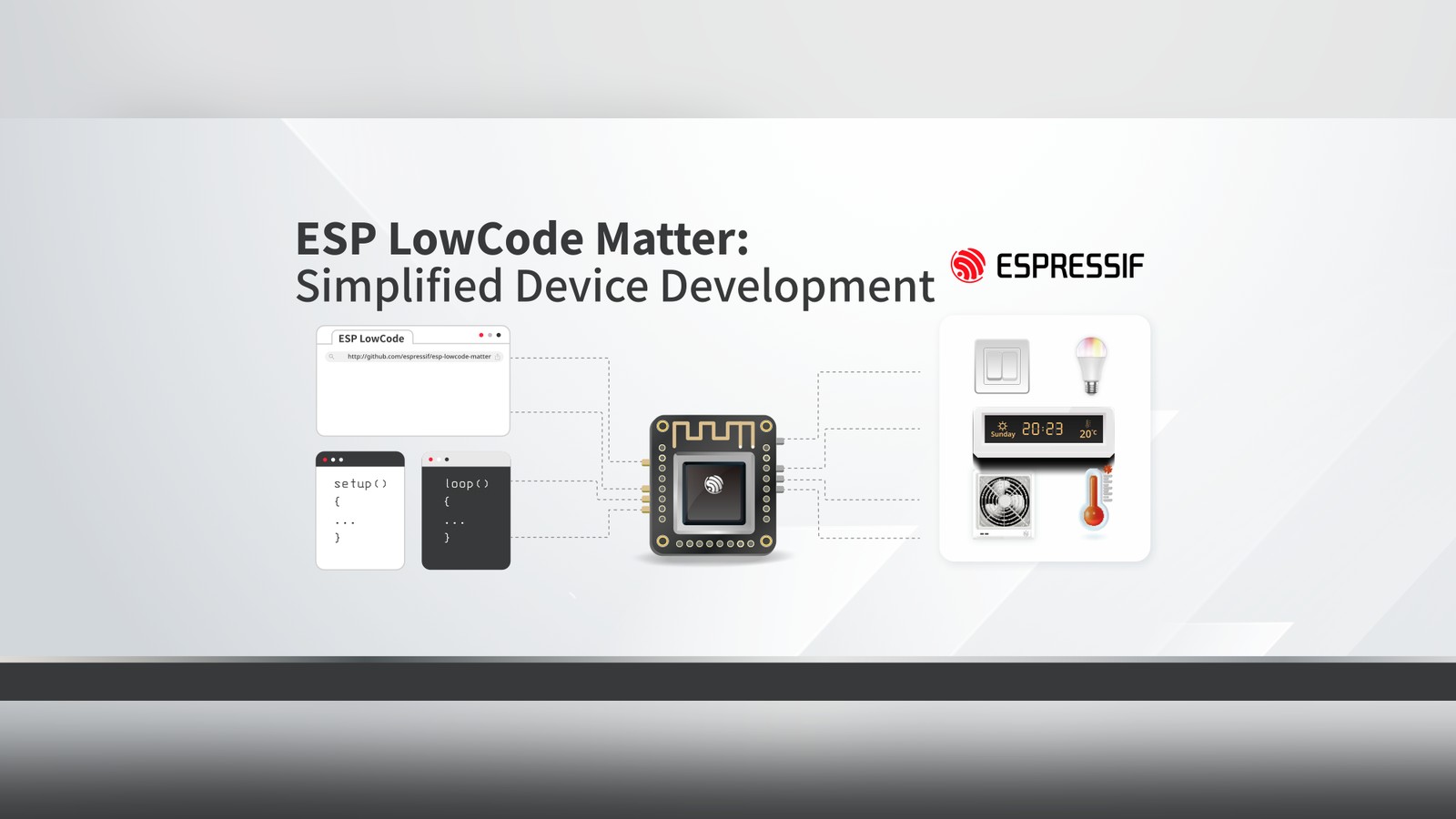
Espressif introduced ESP LowCode Matter on February 27, 2025, to divide that workload. Instead of asking a device maker to build and maintain one large firmware image, the system splits software on a single chip into two parts. Espressif maintains the system firmware, while the product developer writes a smaller application firmware focused on the hardware and user experience.
The first supported system-on-chip was ESP32-C6, whose Wi-Fi 6, Bluetooth Low Energy, and IEEE 802.15.4 radios cover the connectivity Matter products commonly need.
What the two-part design changes
System firmware handles the difficult platform responsibilities: the Matter protocol, security management, and over-the-air updates. Matter is an interoperability standard for connected devices. It defines a common application language so a certified product can be commissioned and controlled by compatible ecosystems without a separate translation layer for each one.
Application firmware handles the product-specific work. It talks to buttons, relays, displays, sensors, motors, and other hardware. It also implements device behavior, event handling, state indication, and the interactions the user actually sees.
The separation resembles a stable platform beneath a small custom program. Espressif described the application style as a familiar setup-and-loop model. The generated application is small, which can shorten the cycle of building, flashing, and debugging changes.
This is more flexible than ESP ZeroCode, Espressif's existing route for creating devices with little or no software development. ZeroCode is useful when its supported customization matches the product. LowCode Matter is intended for teams that need their own hardware logic without taking ownership of the whole Matter stack.
Maintenance is the larger benefit
The easiest part of a connected product's life may be the prototype. Maintenance continues after manufacturing, when protocol updates, security fixes, and field problems arrive. If every vendor modifies its own copy of a large stack, incorporating upstream fixes can become slow and risky.
ESP LowCode Matter keeps the system layer under Espressif's maintenance. The product developer can update its application logic separately while Espressif handles fixes inside the system firmware. That arrangement is meant to reduce the amount of Matter, ESP-IDF, and Connected Home over IP code each device maker must merge and retest.
There is still responsibility on both sides. Application code can create unsafe hardware behavior, mishandle personal data, or expose a poor user interface. A vendor also needs a release process for validating new system firmware with its product. Low-code does not mean no engineering. It means the boundary of the engineering work is narrower.
Manufacturing features are part of the plan
Matter products use a commissioning code, commonly shown as a QR code, to join a user's fabric. A fabric is the trusted group of Matter devices and controllers that share security credentials. Products also require a Device Attestation Certificate, or DAC, which helps a controller verify the device during commissioning.
ESP LowCode Matter includes workflows for generating and flashing unique QR codes and DACs. Development units can use test credentials. For manufacturing, Espressif said its Matter manufacturing service could supply modules programmed with production certificates.
The reason is simple: a shared development credential is not suitable for a shipping product. Every manufactured unit needs correct identity data, and those secrets must be handled securely from provisioning through field operation.
Certification still applies
LowCode Matter does not grant automatic Matter certification. Espressif said products still need full certification and testing. Its claim is that a tested, maintained system firmware should make compatibility work more predictable, and that Espressif can assist manufacturers with certification and keeping it current.
This is an important limitation for small teams. A prototype that pairs with a phone is not the same as a certified product ready for sale. Radio approvals, electrical safety, product security, manufacturing quality, and ecosystem requirements can all apply in addition to Matter testing.
The architecture may still reduce repeated work. When common protocol behavior lives in one maintained platform, product teams can spend more of their certification effort on the parts they changed.
Browser-based development lowers setup friction
Espressif also presented the workflow as browser-accessible. A web tool can configure a device, select its Matter data model, generate application code, and support flashing without requiring every developer to assemble the complete toolchain first.
The data model describes what the device is and what it can do. It is composed of endpoints, clusters, attributes, and commands. A light might expose on/off and brightness controls, while a temperature sensor reports a measured value. LowCode Matter keeps that description outside the system firmware as a pluggable component that the platform interprets.
This approach helps at the beginning, but teams should still place generated sources and configuration under version control. A reproducible product needs a record of the tool version, system firmware version, data model, application code, and manufacturing settings used for each release.
Who should consider it?
ESP LowCode Matter is aimed at device makers who know their own hardware well but do not want to become maintainers of a complete connectivity stack. A company building switches, lights, plugs, sensors, thermostats, or small appliances fits that description. It may also help educators explain Matter concepts without beginning with a large framework build.
Developers who need deep changes to the protocol layer may prefer ESP-Matter or the upstream Connected Home over IP SDK. Those routes provide more control at the cost of more code and maintenance. ZeroCode sits at the other end, offering the least programming and the least freedom. LowCode occupies the middle.
That middle ground is the real announcement. Matter adoption depends not only on capable radios and open specifications, but also on practical ways to build, certify, and maintain products. By separating common platform responsibilities from device-specific logic, Espressif is trying to make the recurring work smaller without reducing a product to a fixed template.
I'd treat LowCode Matter as a way to avoid owning the whole protocol stack, not a shortcut around certification. Plan for the certification work from the start.
Sources and image credits
- Espressif Developer Portal: Introducing ESP LowCode Matter
- Official Developer Portal image supplied by Espressif Systems.
- Square and vertical crops are edited from the same source image.