DIY Electronics

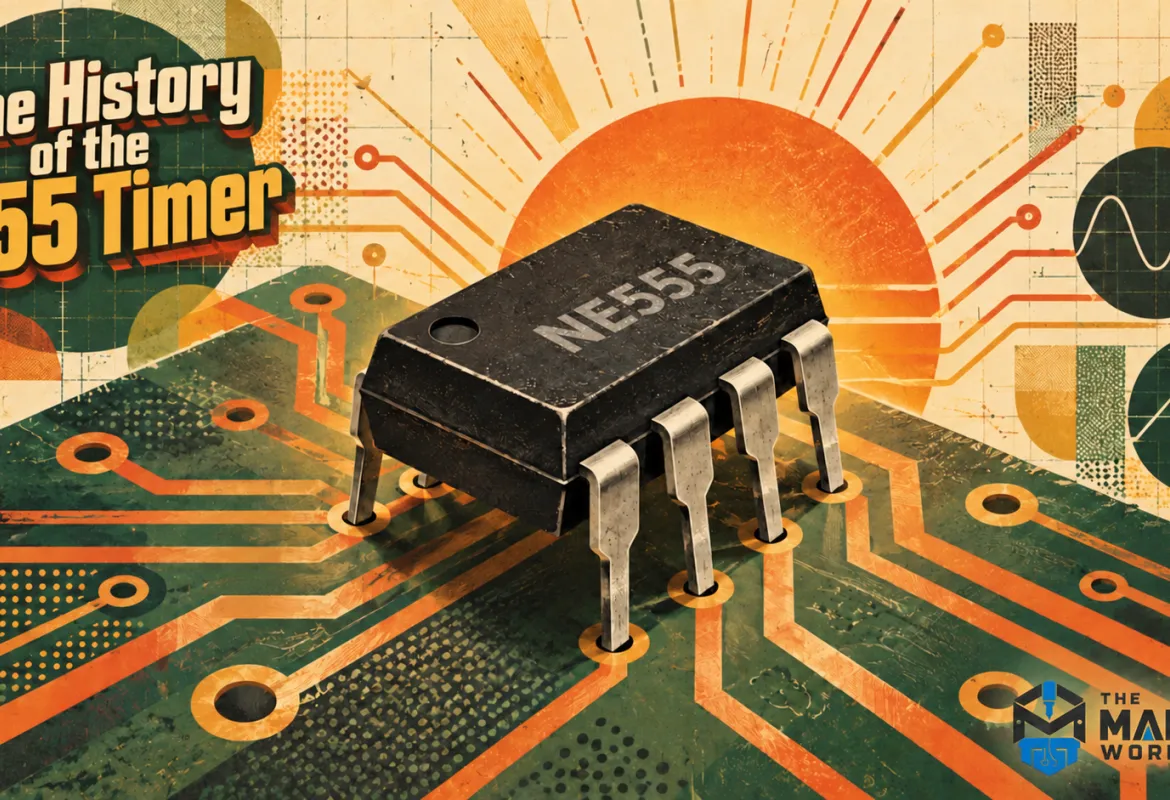
The History of the 555 Timer

Submitted by Charles Gantt on October 22, 2026

How a recession, a consulting contract and a drive home produced the 555 timer, the eight-pin chip that has kept blinking LEDs for more than fifty years.
DIY Electronics
standard
Mastering Arduino Part 12 cover: I2C, Addressing a Bus, with SDA and SCL, 7-bit address, pull-ups and ACK/NACK panels
Mastering Arduino Part 12: I2C, Addressing a Bus
Learn how I2C shares two wires among many devices: open-drain lines and pull-ups, 7-bit addresses, the Wire library, scanning for devices, and putting two on one bus.
Mastering ESP32 Part 2: a laptop showing Boards Manager beside an ESP32 development board and the title Install ESP32 in Arduino IDE
Mastering ESP32 Part 2: Installing and Configuring ESP32 Support in Arduino IDE
Add Espressif's stable board index, install the esp32 core, choose the right board entry, and upload your first sketch to a classic ESP32 DevKit in Arduino IDE 2.
A wattmeter dial with glowing wires linking a voltmeter, an ammeter and a lamp, beside the title How Electronics Work, Part 8, How Electrical Power Works
How Electrical Power Works: Mastering Fundamental Electronics Part 08
Learn how electrical power works: watts as a rate, P = VI, resistor heating, source and load signs, efficiency, and a worked LED resistor example.
A vintage oscilloscope with a flat trace and a battery driving glowing charges around a loop, beside the title How Electronics Work, Part 7, How Direct Current (DC) Works
How Direct Current (DC) Works: Mastering Fundamental Electronics Part 07
Learn how direct current works: polarity, the complete path, steady versus rippled DC, common sources, and why a real battery sags under load.
A vintage oscilloscope showing a sine wave with reversing charges, beside the title How Electronics Work, Part 6, How Alternating Current (AC) Works
How Alternating Current (AC) Works: Mastering Fundamental Electronics Part 06
Learn how alternating current works: what alternates, how to read a sine wave, frequency, period, phase, and why a 120V RMS supply peaks near 170V.
Mastering ESP32 Part 1 card (horizontal)
Mastering ESP32 Part 1: Getting Started with the ESP32: A Complete Beginner's Guide
New to the ESP32? Learn what it is, what's inside, which variant and dev board to buy, how to read the pinout safely, and how it compares with an Arduino Uno.